One that answers. One that acts.
The same building blocks — persona, skills, knowledge — power two complementary kinds of agent. You start with the first and grow into the second.
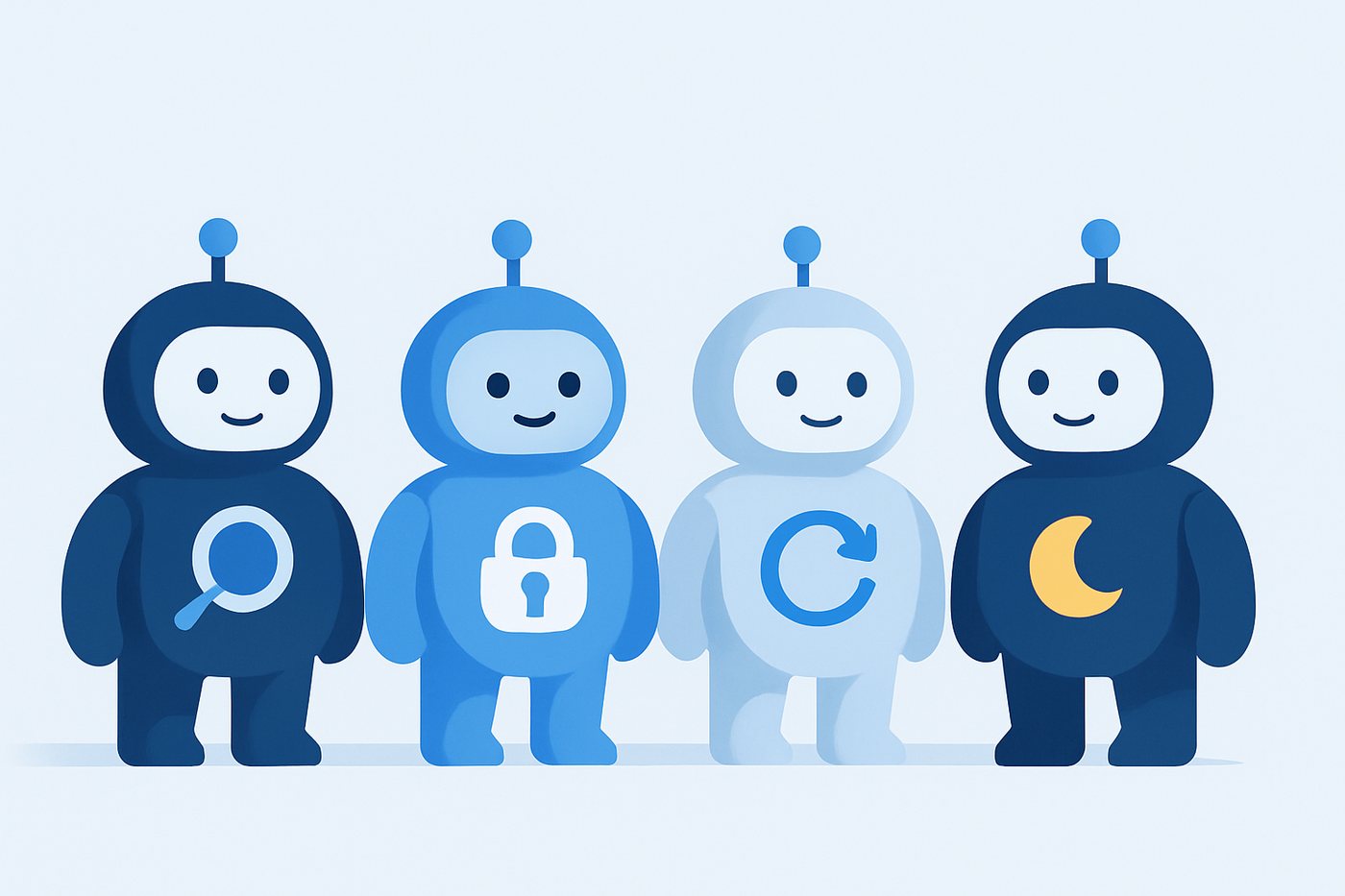
Chat agents
A persona that waits to be asked. It lives docked beside a screen and answers questions about the work in front of the user — grounded in the team's knowledge, acting only through the skills it's been given.
Think of it as the team's best expert, on call from every screen, who never gets tired of the same question.
Workflow agents
A persona that never waits to be asked. It's triggered by an event or a schedule, works through a task on its own using its skills and knowledge, and decides when something genuinely needs a human.
The same idea as a background job — but one that can read, reason, and get better over time, instead of just running fixed code.
A first responder on your incident queue.
Point a workflow agent at a ServiceNow incident queue — the world's most-used service desk. It watches everything coming in, understands each ticket against the team's loaded knowledge, and acts: drafts a resolution, suggests the next step, or flags what genuinely needs a human.
And because it sits inside SAP, the same agent can reach the transactions and data the ticket is actually about — not just talk about them. A tireless first responder that already knows your application, because the responsible team taught it once, in the Hub.
Incident queue · MM
monitored by AI Core| Incident | Subject | Status |
|---|---|---|
| INC0042918 | Stock mismatch | AI drafted |
| INC0042920 | MRP run failed | AI drafted |
| INC0042925 | Field meaning? | AI answered |
| INC0042931 | Pricing exception | Needs human |
| INC0042933 | New material setup | New |
Nightly run · billing exceptions
AI background job| Step | What the agent did | Outcome |
|---|---|---|
| 1 | Read the run output (1,204 lines) | parsed |
| 2 | Clustered 38 errors into 4 causes | analysed |
| 3 | Re-ran 26 safe cases as a new job | resolved |
| 4 | Drafted notes for 9 known issues | drafted |
| 5 | Escalated 3 genuinely new cases | to human |
A background job that can read and reason.
A report runs overnight and produces a long output list — the kind a person normally scrolls through the next morning. Because the agent lives inside the system, it reads that output directly, understands what it's looking at, and decides what to do next.
It can launch follow-on jobs, run the right programs, and re-process the safe cases — everything a background job can do — while drafting explanations for the known issues and escalating only the genuinely new ones. And every clean resolution it finds is remembered, so next month's run needs even less attention.
More places a workflow agent earns its keep.
Master-data quality
Watches new and changed master data, flags inconsistencies against your rules, and drafts the corrections for review.
Interface monitor
Catches failed IDocs and interface errors, diagnoses the cause, re-processes the safe ones, and escalates the rest with context.
Document intake
Reads incoming documents and emails, extracts the data, and creates or updates records through validated skills.
Close & batch watch
Monitors month-end and batch runs, retries what's safe, and surfaces only the exceptions that need a person — with a plain-language summary.